What is Collaborative Care?
Hospice and Palliative Care of Martha’s Vineyard has always offered spiritual and emotional care to our patients and their circles of support. Our spiritual and psychoemotional caregiver group is called the Collaborative Care Team. This team provides integration of spiritual care, social work, and counseling with our medical services. They bring expertise in patient and family care, including end-of-life and anticipatory grief counseling, legacy projects, resource access and residential placement support, family communication, advance directives, prayer, meditation, and end-of-life rituals and services. The CCT also creates and facilitates support groups, our family grief camp, and remembrance events for HPCMV staff, volunteers, and the community.
Collaborative Care Team Services
Grief Counseling
Vivamus suscipit tortor eget felis porttitor volutpat. Proin eget tortor risus.
Social Work Support
Vivamus suscipit tortor eget felis porttitor volutpat. Proin eget tortor risus.
Spiritual Care
Vivamus suscipit tortor eget felis porttitor volutpat. Proin eget tortor risus.
What makes our Collaborative Care Team unique?
- Provides individual and group bereavement counseling for caregivers and family members of patients and the broader Island community.
- Responds to community crises involving sudden or unexpected death.
- Collaborates with community organizations and Island school systems to expand bereavement care for youth and families.
- Led a pilot student grief group at MVRHS, which became an ongoing program.
- With support from the Martha’s Vineyard Community Foundation, continues to build capacity for bereavement support and counseling for children and youth on Martha’s Vineyard.
- Plans and organizes Camp By The Sea, a family grief camp that takes place annually in the fall since Oct. 2024.
- Upholds the HPCMV tradition of community care, recognizing that grief affects everyone.
- Offers emotional and spiritual support to:
- HPCMV staff, board members, and volunteers
- Martha’s Vineyard Hospital and Windemere Nursing Facility staff
- Island school teachers, staff, administrators, and other Island organizations
The Hospice Circles of Care
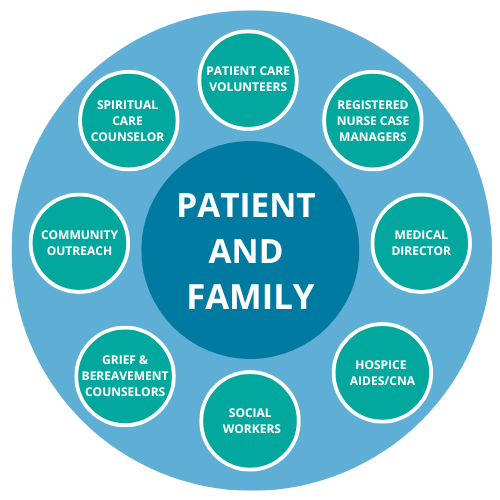
This model visualizes the Hospice support network for a patient and their family, emphasizing that care extends beyond just the hospice medical team.
Hospice Care FAQ
What can I expect from Hospice care?
Palliative care aims to offers relief from distressing symptoms like pain, shortness of breath, fatigue, constipation, nausea, poor appetite, stress and trouble sleeping. It supports your ability to continue daily activities and helps you manage your medical treatments more effectively. Palliative care also empowers you to better understand your illness and explore your options for care. Ultimately, the goal is to help you achieve the best possible quality of life.
How do I receive palliative care?
Let your doctors or nurses know that you’d like to see the palliative care team. They’re there to support you and your family alongside your current care.
Palliative care can be delivered in many settings, including hospitals, outpatient clinics, and in the comfort of your home.
The palliative care team partners with your existing doctors to provide extra support—not just for you, but for your whole family. This team offers expert symptom management, dedicated time to discuss your goals and care options, and guidance to help you navigate the healthcare system.
How is palliative care paid for?
Palliative Care services provided by Hospice and Palliative Care of Martha’s Vineyard are not reimbursed by insurance and are paid for through fundraising, grants, and other philanthropy.
Can I still see my doctors?
Yes, you can still see all your regular doctors while receiving palliative care.
Palliative care is an added layer of support that works with your current medical team. The palliative care team collaborates with your primary care doctor, specialists, and other healthcare providers to help manage symptoms, improve communication, and support your overall well-being—without replacing your current doctors.
Who is eligible for palliative care?
Anyone living with a serious illness can be eligible for palliative care—at any age and at any stage of the illness.
You don’t need to stop treatment or be near end of life to receive it. Palliative care can be provided alongside curative or life-prolonging treatments to help manage symptoms, improve comfort, and support decision-making.
Common conditions that may qualify you for palliative care:
- Cancer
- Heart disease (like CHF)
- Lung diseases (like COPD)
- Kidney failure
- Liver disease
- Alzheimer’s or other dementias
- Parkinson’s disease
- Stroke
- And more
If an illness causes pain, symptoms, or stress that affects your quality of life, you could benefit from palliative care.
What are the benefits of palliative care?
- Symptom Relief: Eases pain, fatigue, and other uncomfortable symptoms
- Emotional & Family Support: Helps with decision-making, care planning, and reducing caregiver stress
- Improved Quality of Life: Supports daily living and aligns care with your values
- Cost Savings: Reduces hospital visits and unnecessary treatments, lowering overall healthcare costs